Ice Bath Benefits: What Cold Water Immersion Actually Does
 Dr. Ronak PatelPerformance Physiotherapist
Ice baths reliably reduce muscle soreness after hard training and help athletes feel recovered sooner, mostly by constricting blood vessels, slowing nerve signalling and lowering the perception of pain.
What they do not do is repair tissue faster on their own, and used immediately after strength training they can blunt some muscle-building adaptations.
Used at the right time, with a controlled protocol of roughly 3 to 5 degrees Celsius for short exposures, they are a genuinely useful recovery tool.
Cold water immersion has gone from a niche athlete habit to a full internet obsession. Somewhere between the influencer plunge videos and the miracle claims, the actual physiology got lost.
Here is the honest version from a clinic that runs a clinical ice bath protocol every week: ice baths do some things very well, some things modestly, and some things not at all. Knowing which is which decides whether the cold works for you or against you.
What actually happens in your body in cold water
The moment you submerge, blood vessels near the skin constrict hard. Blood shifts toward your core to protect organ temperature.
Your heart rate spikes, then settles as the initial shock passes. Nerve conduction slows, which is why pain and soreness feel duller during and after immersion.
Metabolic activity in the cooled tissue drops, and the post-exercise inflammatory response is turned down a notch.
When you get out, the vessels reopen and blood flow returns in a rush. Many people describe a clear-headed, energised feeling afterwards, which is partly a catecholamine response, the same family of chemicals behind alertness and drive.
None of this is mystical. It is a strong, predictable stress-and-rebound cycle, and that cycle is the tool.
The benefits with good evidence behind them
Being honest about evidence matters more in recovery than almost anywhere else, because the marketing runs so far ahead of the science. Research consistently shows cold water immersion reduces the perception of delayed onset muscle soreness in the day or two after hard exercise.
Athletes who use it between heavy sessions or tournament matches routinely report feeling fresher for the next effort, and that subjective readiness is a real performance variable, not a rounding error.
- Less soreness. The most consistent finding. Cold blunts the soreness signal after unaccustomed or very hard exercise.
- Faster perceived recovery. Athletes feel ready to go again sooner, which matters in congested competition schedules.
- Acute swelling control. Vessel constriction limits fluid pooling in worked or mildly irritated tissue.
- A trainable stress response. Repeated controlled exposure teaches you to stay calm under a strong stressor, and that composure transfers.
What ice baths do not do
An ice bath does not repair a muscle tear, fix a tendon, or substitute for rehab. It does not burn meaningful amounts of fat in a ten-minute session, whatever the thumbnail promised.
And it does not accelerate the underlying tissue repair process; it mostly changes signalling, fluid dynamics and how recovery feels. That last part is genuinely valuable, but it is not the same as healing faster at the cellular level.
If you have an actual injury, cold is a comfort tool while a professional works out what is wrong, not a treatment plan. Pain that keeps returning after every plunge is your body asking for an assessment, not a colder bath.
The timing problem: cold water and muscle growth
Here is the nuance most cold-plunge content skips. The inflammation you feel after strength training is not purely a bad thing.
Part of that inflammatory signalling is the trigger for muscle adaptation. Research in strength athletes suggests that routinely icing immediately after lifting can blunt some of the long-term muscle growth and strength gains that the session was supposed to produce.
The practical rule we give athletes is simple. If the goal of today's session was adaptation, getting bigger, stronger or faster, keep the ice bath several hours away from it or save it for another day.
If the goal is to feel fresh for tomorrow's match, semifinal or race, plunge away. Cold is a competition-phase tool first and a hypertrophy-phase tool almost never.
| Situation | Use an ice bath? | Why |
|---|---|---|
| Between tournament matches | Yes | Freshness for the next effort beats everything |
| After a brutal conditioning block | Yes, if very sore | Soreness relief helps you keep training |
| Right after heavy strength work | Avoid | May blunt the adaptation you trained for |
| During a muscle-building phase | Rarely | Let the inflammation do its signalling job |
| Fresh acute injury | Not as therapy | Get assessed first, cold is comfort only |
What a proper clinical protocol looks like
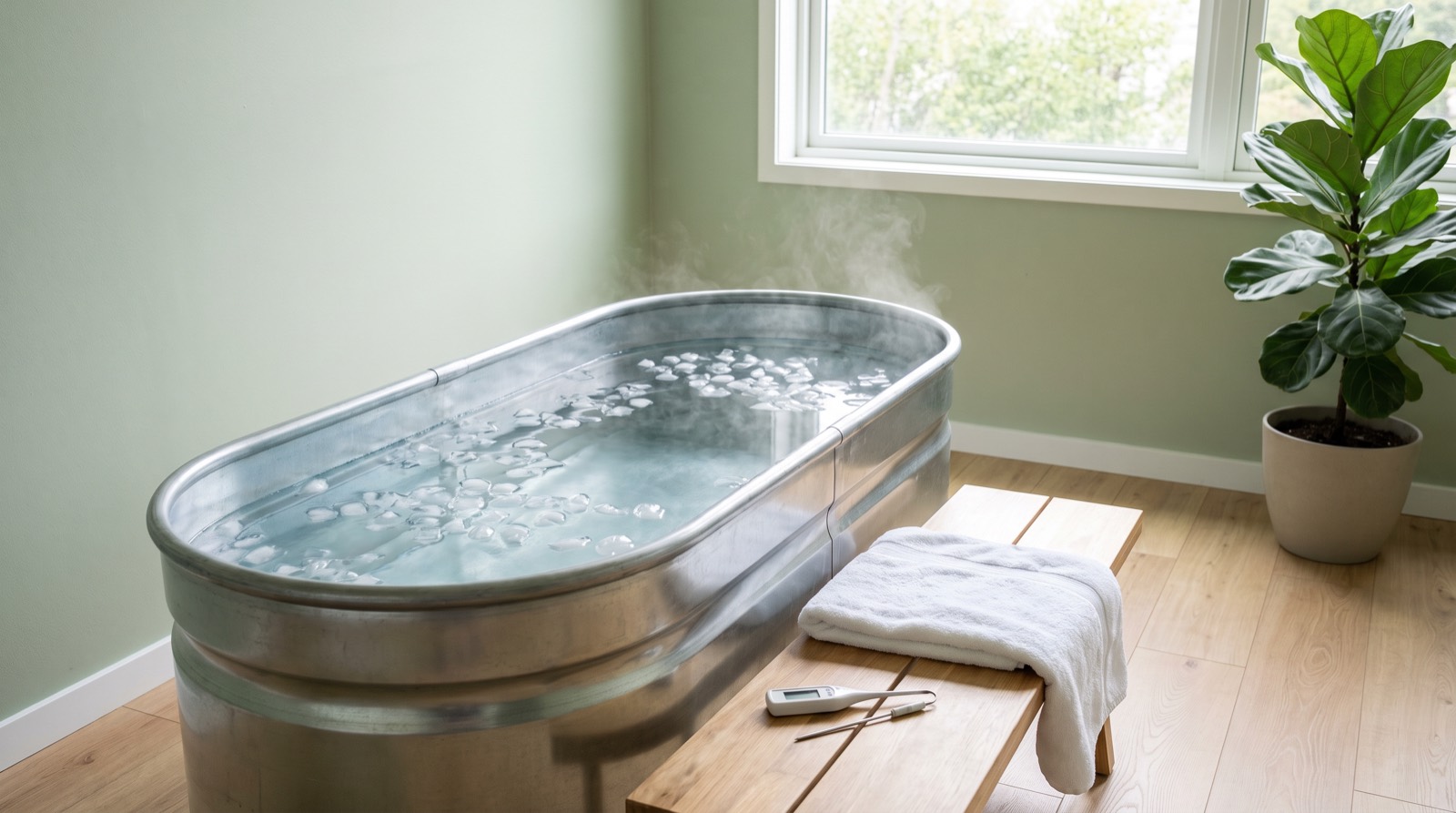
The difference between a controlled protocol and a bathtub full of ice slabs is control. At SattvaRig's recovery zone in Ahmedabad, the ice bath runs at a monitored 3 to 5 degrees Celsius, exposures are short and timed, and someone is always supervising.
Temperature control matters because the response you get at 5 degrees for three minutes is very different from 12 degrees for fifteen, and most home setups have no idea which one they are delivering.
- Check suitability first. Heart conditions, uncontrolled blood pressure, pregnancy, and certain skin or circulation problems need medical clearance.
- Enter controlled and exhale slowly. The gasp reflex passes in about 30 to 60 seconds if you breathe long and slow.
- Keep the first exposures short. One to three minutes is plenty when the water is truly cold.
- Get out, do not tough it out. Shivering that will not settle, numb white skin or dizziness means the session is over.
- Rewarm actively. Walk, layer up, sip something warm. Avoid a scalding shower immediately after.
The recovery zone runs a monitored 3 to 5 degree clinical protocol with a professional walking you through every minute.
Ice bath vs cold shower: is a shower enough?
A cold shower is a fine wake-up habit and a gentle introduction to deliberate cold, but it is not the same stimulus. Showers rarely get water below 15 to 20 degrees in most Indian cities, only part of your body is exposed at a time, and there is no hydrostatic pressure squeezing fluid out of the limbs.
Full immersion in genuinely cold water is a different physiological event. If your goal is a mood boost, shower away.
If your goal is post-competition recovery, immersion does the job the shower cannot.
How cold, how long, how often
Colder water needs less time. At a true 3 to 5 degrees, two to five minutes is a strong dose.
At 10 to 12 degrees, sessions often stretch toward ten minutes to achieve a similar effect. Frequency depends on the goal: around competition, daily immersion for a short block is common; in general training, one to three sessions a week is plenty.
More is not better. Cold is a stressor, and stacking it endlessly on top of training stress defeats the purpose of recovery.
Where heat and contrast bathing fit
Cold is not the only temperature tool. Sauna and warm immersion relax muscles, ease stiffness and help many people sleep better, and contrast bathing, alternating warm and cold, is popular with athletes who like the pumping sensation it creates in tired legs.
The evidence for contrast work sits in the same modest, useful range as cold alone: good for perceived soreness and freshness, not a repair accelerator. A sensible way to choose: cold when the goal is next-day readiness around competition, heat when the goal is unwinding stiff, tense tissue and better sleep, and either one only after the basics of food and rest are already handled.
Who should not get in an ice bath
Cold immersion is a significant cardiovascular event. People with heart disease, arrhythmias, uncontrolled high blood pressure, Raynaud's phenomenon, cold urticaria or open wounds should not plunge without explicit medical clearance.
Pregnant women should speak to their doctor first. And nobody should do their first genuinely cold immersion alone, in deep water, or after alcohol.
If you experience chest pain, severe breathlessness or fainting around cold exposure, that is a doctor-now situation, not something to push through.
Common ice bath myths, sorted
- "It flushes lactic acid." Lactate clears on its own within about an hour of exercise regardless. Cold does other useful things, but this is not one of them.
- "Longer is better." No. Dose matters, and past a point you are just risking cold injury for zero extra benefit.
- "It melts fat." Cold exposure nudges metabolism slightly. It does not replace training or nutrition, not even close.
- "Everyone should do it daily." Recovery tools should match training goals. Daily cold during a strength block can quietly work against you.
How to build cold into a real recovery system
Cold water is one instrument, not the orchestra. It works best layered on the boring fundamentals: sleep, protein, planned recovery days, and graded training load.
In our recovery sessions, immersion usually sits alongside mobility work and soft tissue treatment rather than replacing them. If soreness is your recurring problem, it is also worth reading how DOMS actually works, because the fix is usually in the training plan, not the tub.
What a first supervised session feels like
Expect a short brief on breathing, a temperature check, and a timed entry. The first 30 seconds feel loud, your breath wants to run away and your skin screams.
Then it goes quiet. Most first-timers are surprised that minute two feels manageable and minute three almost calm.
You step out, rewarm, and somewhere in the next half hour a distinct lightness shows up in the legs. That is the moment people usually get hooked, and it is also the moment to remember everything above about timing and dose.
The bottom line
Ice baths are a legitimate, well-supported tool for reducing soreness and speeding the feeling of recovery, especially around competition. They are not a healing shortcut, and used carelessly after strength training they can cost you adaptation.
Respect the dose, respect the contraindications, and put the cold where it belongs: in service of your training, not in place of it. If you want the supervised version, with real temperature control and a physio watching your response, the recovery zone is exactly what it is for.
Frequently asked questions
Yes, for specific things. Cold water immersion reliably reduces the perception of muscle soreness and helps athletes feel ready to perform again sooner. It does not speed up tissue repair itself, so it works best as a between-sessions freshness tool, not a healing treatment.
A clinical protocol typically runs around 3 to 5 degrees Celsius with short, timed exposures of roughly two to five minutes. At milder temperatures like 10 to 12 degrees, sessions need to be longer to achieve a similar effect. Colder always means shorter.
Preferably not immediately after. The inflammation following strength training is part of the signal that drives muscle growth, and routine cold immersion straight after lifting can blunt those gains. Keep cold several hours away from strength work, or use it on separate days.
Anyone with heart disease, arrhythmias, uncontrolled blood pressure, Raynaud's phenomenon, cold urticaria or open wounds should get medical clearance first, and pregnant women should check with their doctor. First exposures should always be supervised, never alone or after alcohol.
No. Showers rarely get cold enough, expose only part of the body at a time, and lack the hydrostatic pressure of full immersion. A cold shower is a decent daily habit; a controlled full-body immersion is a different and much stronger recovery stimulus.
Get answers for your body
Reading helps. An assessment fixes. Your first session at SattvaRig is a full strength and mobility assessment at Science City or Shilaj, Ahmedabad.